The P39-1 is an anonymous stretch of thinly tarred highway connecting the small towns of Newcastle and Normandien in South Africa, a four-hour drive from Johannesburg.
This week the single carriageway road, which runs mainly along the edge of farms nestled in the remote hills of the country’s KwaZulu-Natal province, has found itself unexpectedly the subject of global attention.
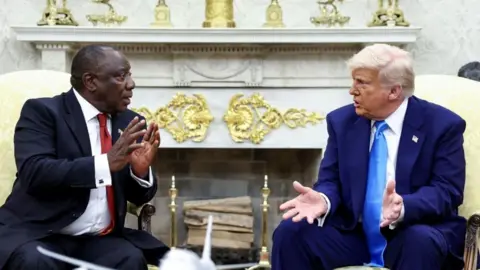
On Wednesday many South Africans were among those watching live around the world as US President Donald Trump ambushed his South African counterpart Cyril Ramaphosa with a video making the case that white people were being persecuted. He had previously said that a “genocide” was taking place.
The most striking scene in the video was an aerial shot of thousands of white crosses by the side of the road – a “burial site” President Trump repeatedly said, of more than a thousand Afrikaners murdered in recent years.
The president did not mention where the road was although the film was quickly linked to Normandien.
But the people who live nearby know better than anyone that his claim is not true.
The BBC visited the area on Thursday, the day after the Oval Office showdown, to find that the P39-1’s crosses have long since disappeared.
There is no burial site, and the road looks like any other. A new grain mill has been built along one stretch where the crosses once briefly stood.
What we found was a community shocked to find itself under the spotlight, and a truth about the crosses that reveals much about the delicate balance of race relations in South Africa.
Roland Collyer is a man who understands both.
A farmer from South Africa’s Afrikaner community, it was the murder of his aunt and uncle Glen and Vida Rafferty, bludgeoned to death in their home five years ago, which led to the erection of the crosses.
Their deaths at their farm, by attackers who stole valuables from their home, led to a public outcry by the farming community, and the temporary planting of the crosses by fellow Afrikaners keen to highlight their murders among those of other farmers who have been killed across South Africa.
“So the video that you guys have been seeing,” he tells me as we stand together by the roadside, “happened along this section of the road.”
Pointing down the hill, towards a village where many black families live in mud huts, he explains: “There were crosses planted on both sides of the road, representing lives that have been taken on farms, farm murders. All the way from the bridge down below, up to where we’re standing at the moment.
“The crosses were symbolic, to what was happening in the country.”
 Reuters
One of the Raffertys’ neighbours, businessman Rob Hoatson, told the BBC how he organised the crosses to capture public attention, such was the shock over the couple’s deaths.
“It’s not a burial site,” he explained, saying Trump was prone to “exaggeration”, adding though that he did not mind the image of the crosses being used. “It was a memorial. It was not a permanent memorial that was erected. It was a temporary memorial.”
Mr Collyer continues to farm in the area but says the Raffertys’ two sons left after their parents’ murders. The younger, he explains, has moved to Australia while the elder has sold up and left farming to relocate to the city.
Many people remain scared for their future in South Africa, which has one of the highest murder rates in the world.
In 2022, two local men Doctor Fikane Ngwenya and Sibongiseni Madondo were convicted for the murders of the Raffertys, as well as robbery, and sentenced to life and 21 years imprisonment respectively.
For many in the local community it was a rare act of justice, with thousands of murders remaining unsolved across a country which President Ramaphosa told President Trump has yet to get a grip of its soaring crime rate.
The Raffertys’ murders sparked a period of heightened racial tension in the area.
South Africa’s police minister was forced to visit to try to bring calm, with protests from Afrikaners mirrored by claims from some members of the local black community of mistreatment by white farmers.